Buy heralogic.eu ?
We are moving the project
heralogic.eu .
Are you interested in purchasing the domain
heralogic.eu ?
domain@kv-gmbh.de · 0541-91531010
Buy heralogic.eu ?
What is the name of this mobile phone song Ai di di di di di di dai? I think it's a Russian song.
The song you are referring to is "Ai, Ai, Ai" by the Russian artist Polina Gagarina. It is a popular Russian pop song that gained international recognition. The catchy melody and upbeat rhythm have made it a favorite for mobile phone ringtones and music downloads. If you enjoy this song, you may also like other hits by Polina Gagarina. **
What is the difference between il faut que and il faut?
"Il faut" is used to express a general necessity or obligation, while "il faut que" is used to introduce a specific action or event that is necessary or required. For example, "il faut manger" means "it is necessary to eat" in a general sense, while "il faut que tu manges" means "you need to eat" in a specific sense. "Il faut" is used to make a general statement about what is necessary, while "il faut que" is used to specify what needs to be done. **

Similar search terms for Il-Colombaio-di-Santa
Top-Angebote
Products related to Il-Colombaio-di-Santa:
-
Il Randagio Tenuta di Carleone 2024The Tuscan winery Tenuta di Carleone introduces the Rosso 'Il Randagio', a bottle that highlights a new take on the Radda in Chianti area, interpreted through a blend of the international Merlot and Cabernet Franc grape varieties. The winery itself calls this label the 'Guercino', a nickname that underlines its link with 'Il Guercio', one of Tenuta di Carleone's flagship wines. In fact, the two bottles share the same production process, based on the exclusive use of cement vats, a certain presence of whole bunches in the vinification process and a long skin maceration. The substantial distinction between the two wines lies in the grape varieties used: Sangiovese for 'Il Guercio', Cabernet Franc and Merlot for 'Il Randagio'.The Rosso Tenuta di Carleone 'Il Randagio' derives from an equivalent blend of Merlot and Cabernet Franc grapes, varieties cultivated following the dictates of organic and biodynamic agriculture. Harvesting is carried out entirely by hand and the grapes are then vinified in cement vats through spontaneous alcoholic fermentation with a percentage of whole bunches, combined with no less than 4 months of maceration on the skins. The ageing phase, which lasts 12 months, also takes place in cement and the wine is finally bottled without undergoing any clarification or filtration.Tenuta di Carleone's 'Il Randagio' Rosso has an intense, dark ruby red colour. The nose is played on notes of dark fruit such as plum and blackberry and typical varietal hints of black pepper and green pepper, all supported by an intriguing spicy texture. The taste, soft, fresh and juicy, is characterised by pleasant tannin that anticipates the drinkable and pleasantly free-range finish.19,00 £*Shipping: 48,00 £Secure redirect to the provider
-
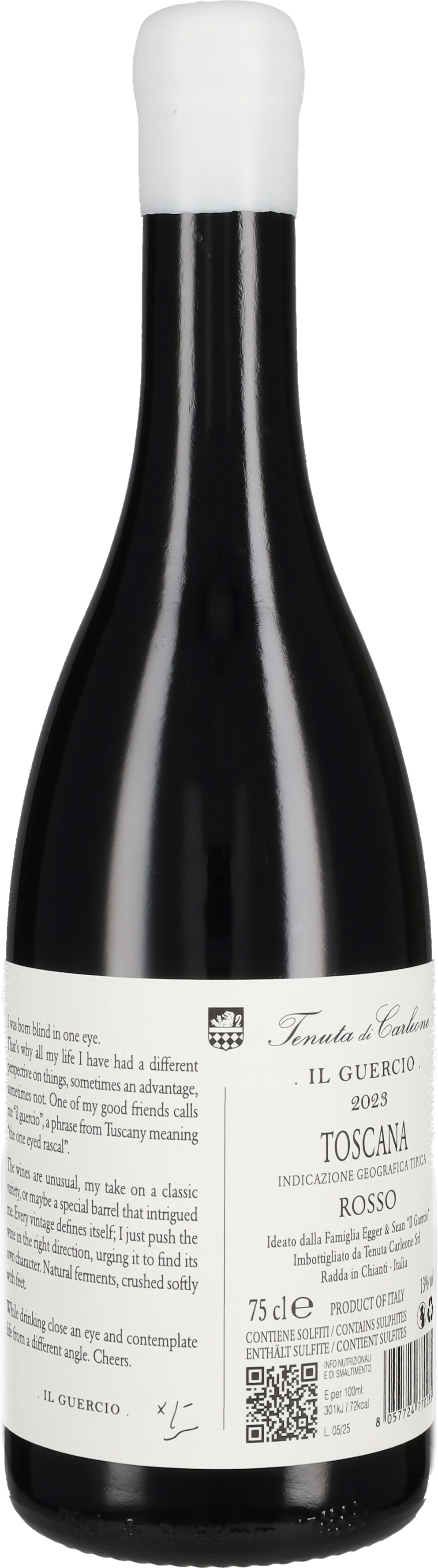
Il Guercio Tenuta di Carleone 2024Tenuta di Carleone's 'Il Guercio' is a Tuscan red wine capable of revealing the freshest and most modern character of Sangiovese, all played on fruit and crispness, the expression of a single high altitude vineyard in the municipality of Lamole. The name of the label pays homage to Sean O'Callaghan, the skilled English oenologist in charge of Tenuta di Carleone's artisanal production, nicknamed 'Il Guercio'. This expression, meaning a person who is cross-eyed or almost blind in one eye, is a reference to Sean's offended eye, a distinctive trait of the oenologist.Tenuta di Carleone 'Il Guercio' is a pure Sangiovese whose grapes come from a single old terraced vineyard located just outside the village of Lamole, at an altitude of a good 650 metres above sea level. The vines are grown under a certified organic system, supplemented by biodynamic practices, while the harvest is carried out by hand at a late stage to ensure the full ripeness of the grapes, which are then mellowed in cement vats for 30% whole cluster. Here, alcoholic fermentation occurs spontaneously through the intervention of indigenous yeasts alone, accompanied by a very long 4-5 month maceration on the skins, and the wine then rests for approximately 12 months in cement until final bottling, which is carried out without prior clarification or filtration.Tenuta di Carleone's 'Il Guercio' has a dark ruby red colour. On the nose, fragrant aromas of red fruits such as cherry and currant alternate with hints of blackberry, hints of liquorice and orange peel and balsamic nuances. The taste is fresh and intense, soft and drinkable at the same time, with a dense but integrated tannic texture that accompanies the clear sensations of red fruits on the finish of lasting persistence.62,00 £*Shipping: 48,00 £Secure redirect to the provider
-
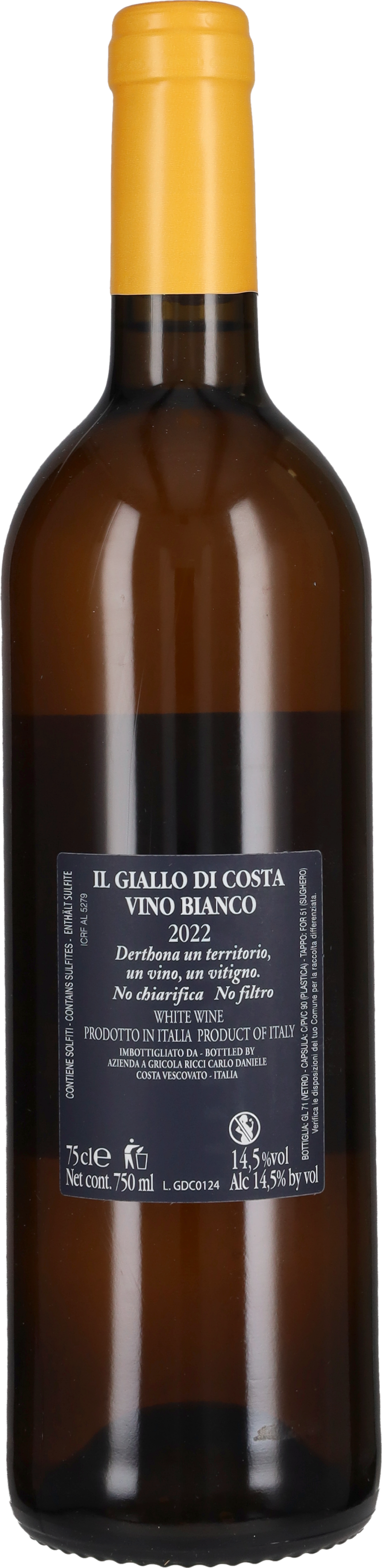
Ricci Daniele 'Il Giallo di Costa' Ricci“Il Giallo di Costa” from the winery Daniele Ricci is an unruly yet enchanting poem. A liquid to approach without ifs and buts, without prejudices, with a clear mind, a blank slate, with an open and curious spirit. This contemporary interpretation and out-of-the-box take on the historic white grape variety cannot certainly leave one indifferent. Here we go beyond Walter Massa, we go beyond the mere valorization of the variety, we go beyond the oenological diktat reaching Nirvana: the authentic and exemplary meeting between the earth, the sky, and the hand of man On several occasions, the winemaker Daniele Ricci has admitted to being particularly attached to “Il Giallo di Costa”, whose first vintage dates back to 2007. The optimal realization of this label is played out almost entirely in the vineyard; because to allow for a maceration of as much as 90 days on the skins, it is necessary to bring perfectly healthy and ripe bunches into the winery. Daniele is well aware of this and tends to his approximately 25-year-old plants embracing the principles of organic farming, certified by the Bios entity. The “Il Giallo di Costa” by Daniele Ricci is not simply a white, it is an orange, brilliant and deep, that macerates on the skins for 90 days with submerged cap in steel tanks. A liquid reincarnation of that “golden style in which the languor of the sun dances” by Paul Verlaine, it emanates ethereal aromas of candied fruit and citrus peel, acacia honey, and toasted hazelnuts, on a green, marine, and mentholated background. When you drink it, it intoxicates you, enriches you, stirs you from within, dismantling one by one the beliefs you thought you held about that grape variety and stimulating you to taste again, anew, from the beginning.31,00 £*Shipping: 48,00 £Secure redirect to the provider
-
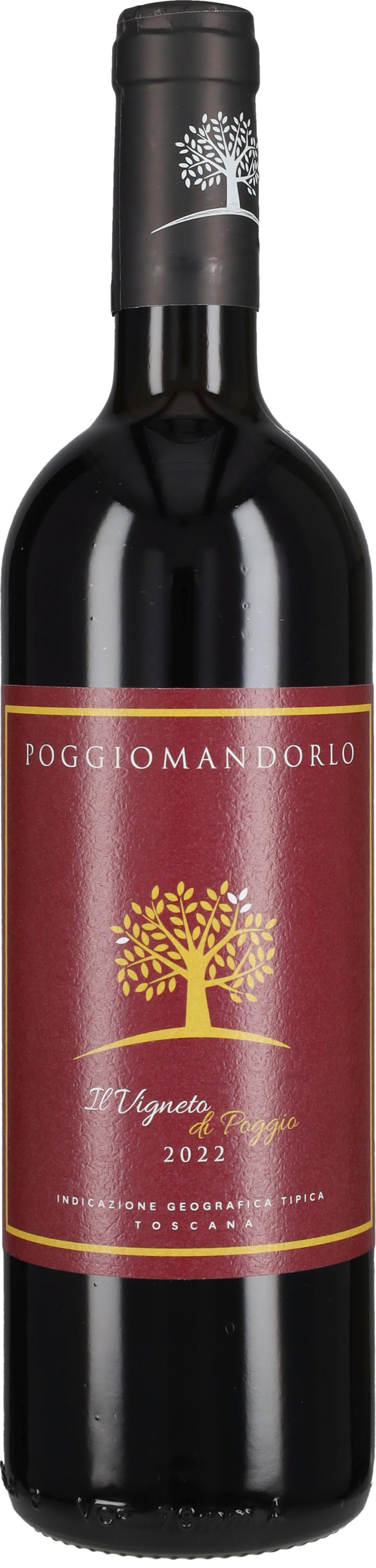
'Il Vigneto di Poggio' Poggio Mandorlo 2022“The Vineyard of Poggio” by Poggio Mandorlo is a proud expression of the rich wine landscape of Maremma. It tells the story of four friends: Roberto, Felice, Giuseppe, and Fabio, who for about twenty years have decided to experiment with the potential of a territory. Supported by the oenologist Roberto Cipresso first and then Filippo Paoletti, noted figures from the Montalcino area, they have managed to navigate the virtues of the Seggiano soils to obtain unique and never banal labels. Located at the crossroads between Val Norcia and the first hills of the Grosseto Maremma, at the foot of the Amiata volcano, the winery decides to cultivate not only Sangiovese but also rare and unique clones of Merlot and Cabernet Franc, which they import directly from Saint-Émilion in the Bordeaux region. The latest offspring of Poggio Mandorlo is precisely “the Vineyard of Poggio”, capable of expressing the versatility of the sandstone and limestone marls on which the Merlot, of which this interesting label is entirely composed, takes root. The vines were planted in 2001 and the harvest is carried out exclusively with manual selection. Fermentation takes place in stainless steel tanks at controlled temperature, during which delicate pump-overs are performed. The maceration period varies from 8 to 12 days and is meticulously monitored through chemical and sensory analysis. The 12 months of aging also take place in steel, giving us a bottle that perfectly expresses the great varietal rigor even through an international grape variety. Poggio Mandorlo with its “Vigneto di Poggio” of pure Merlot envelops us with its shining ruby veil to gift us with scents of wilted rose and wild fruit, pleasant notes of plum, underbrush, cherry, and a finish of black pepper and cinnamon. On the palate, it presents warm aromas for a full body in which the fragrance of red fruit is found, with a pleasant fresh shoulder softened by a good sapidity, the tannin is tasty and almost caressing. Poggio Mandorlo expresses all its commitment to the passion for the land and the love for good wine, reflecting in the personality of this pleasing label.12,00 £*Shipping: 48,00 £Secure redirect to the provider

-
When do you use il faut and il ne faut pas?
"Il faut" is used to express what is necessary or required, while "il ne faut pas" is used to express what is not allowed or should be avoided. For example, you would use "il faut" to say "il faut étudier pour réussir" (it is necessary to study to succeed), and "il ne faut pas" to say "il ne faut pas fumer dans ce lieu" (smoking is not allowed in this place). These expressions are used to give advice, make recommendations, or set rules. **
-
Why is it souhaite-t-il and not souhaite-s-il?
In French, the pronoun "il" (he) is combined with the verb "souhaiter" (to wish) to form the phrase "souhaite-t-il" because of the rule of verb inversion in interrogative sentences. When forming a question in French, the subject pronoun and the verb are inverted, so "souhaite-t-il" follows this rule. The "t" is added to create a liaison between the verb and the pronoun, making the pronunciation smoother. **
-
What does 'Rucke di guck, Rucke di guck, Blut ist im Schuh' mean?
"Rucke di guck, Rucke di guck, Blut ist im Schuh" is a German nursery rhyme that translates to "Rock-a-bye baby, blood is in the shoe" in English. The rhyme is a traditional lullaby that tells the story of a baby being rocked to sleep while blood is found in their shoe, which is a metaphor for the baby being cared for and protected. The rhyme is meant to soothe and comfort children as they drift off to sleep. **
-
What comes after il faudrait in French?
In French, "il faudrait" is followed by the infinitive form of a verb. This construction is used to express a suggestion or a polite request. For example, "il faudrait partir tôt" means "it would be necessary to leave early." **
How does "il faut" work in French?
"Il faut" is a common expression in French that is used to convey the idea of necessity or obligation. It is followed by an infinitive verb and is used to express what needs to be done or what is necessary in a given situation. For example, "Il faut manger" means "It is necessary to eat." This expression is used to give advice, make suggestions, or express general truths. **
What is an El, Sl, and Il?
An El, Sl, and Il are all suffixes used in the English language to form adjectives. "El" is used to form adjectives that mean "pertaining to" or "characterized by," such as in the word "musical." "Sl" is used to form adjectives that mean "tending to" or "inclined to," such as in the word "careful." "Il" is used to form adjectives that mean "having the nature of" or "capable of," such as in the word "flexible." These suffixes help to create new adjectives by modifying the meaning of the base word. **
Top-Angebote
Products related to Il-Colombaio-di-Santa:
-
Il Colombaio di Santa Chiara Vernaccia di San Gimignano 'Selvabianca' Il Colombaio Santa Chiara 202The Vernaccia di San Gimignano “Selvabianca” from the Tuscan winery Il Colombaio Santa Chiara is the young and fresh version of this interesting indigenous grape variety. The only white DOCG in a land of great reds like Tuscany, Vernaccia expresses wines of great personality. It is a white of good structure, with intense and multifaceted aromas, enhanced in their varietal typicity by the choice to vinify exclusively using steel and cement, without contact with wood. Thanks to its strong character and pleasant taste persistence, it is a wine that pairs very well with first courses of seafood or land cuisine and with delicate-tasting white meats. The “Selvabianca” Vernaccia is produced by one of the most famous and renowned wineries in the area. Founded only in 2000, Il Colombaio Santa Chiara quickly earned a prominent place within the denomination. The estate extends over about twenty hectares, cultivated under organic farming practices, at an altitude between 350 and 400 meters above sea level.of the sea. The vineyards are surrounded by woods and benefit from an unspoiled environment rich in biodiversity. The soils are composed of sands mixed with clays, pebbles, gravel, and limestone. Following the great attention to vineyard work, the winemaking processes are very respectful of the raw materials, preserving the intense aromas and fragrances of the grapes. The wine "Selvabianca" from Il Colombaio Santa Chiara is made from a gentle pressing of whole bunch grapes, followed by fermentation at controlled temperatures in concrete and stainless steel tanks. The wine then rests on its own yeasts for several months before being bottled. In the glass, it presents a light straw yellow color with slight greenish reflections. On the nose, it releases delicate aromas of wildflowers, fragrant citrus notes, lime, white-fleshed fruit aromas, hints of aromatic herbs, and chamomile. On the palate, it expresses an elegant taste, with a tense and savory sip, that vibrantly extends towards a finish of great mineral freshness.17,00 £*Shipping: 48,00 £Secure redirect to the provider
-
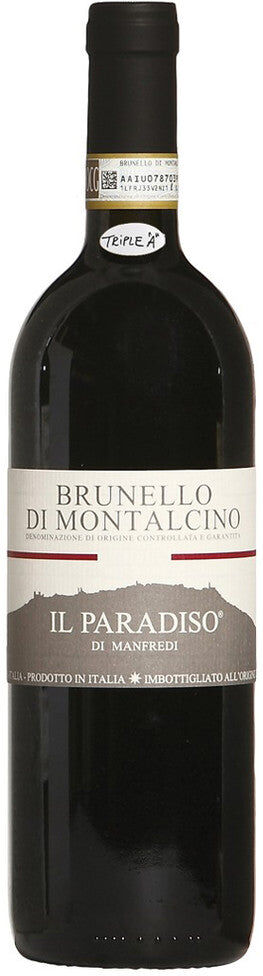
Brunello di Montalcino Il Paradiso di Manfredi 2016This Brunello di Montalcino is a marvel wine signed by Il Paradiso di Manfredi, a bottle of rare elegance and thickness that can amaze every taste. A Brunello unpredictable, sometimes austere, which is left to settle for at least an hour, so that the extraordinary fountain free of fragrances and aromas that hides in garnet color in the glass. Florio Guerrini, author of Il Paradiso di Manfredi, it comes down to compromise: No chemicals in the vineyard, doses of sulfur to almost nothing, yeasts, total respect of nature's cycles. Il Paradiso di Manfredi is a unique, among the most virtuous of all Tuscany. This Brunello is a wine that takes time, that does not give right out of the bottle. A wine unpredictable and unconventional, light years away from wines approved, changing second by second in the glass giving emotions are always different. If you want to taste a Brunello of character, original and changeable, with great elegance and naturalness infinite, this bottle of Il Paradiso di Manfredi is certainly for you. No doubt a great wine.133,00 £*Shipping: 48,00 £Secure redirect to the provider
-
Il Randagio Tenuta di Carleone 2024The Tuscan winery Tenuta di Carleone introduces the Rosso 'Il Randagio', a bottle that highlights a new take on the Radda in Chianti area, interpreted through a blend of the international Merlot and Cabernet Franc grape varieties. The winery itself calls this label the 'Guercino', a nickname that underlines its link with 'Il Guercio', one of Tenuta di Carleone's flagship wines. In fact, the two bottles share the same production process, based on the exclusive use of cement vats, a certain presence of whole bunches in the vinification process and a long skin maceration. The substantial distinction between the two wines lies in the grape varieties used: Sangiovese for 'Il Guercio', Cabernet Franc and Merlot for 'Il Randagio'.The Rosso Tenuta di Carleone 'Il Randagio' derives from an equivalent blend of Merlot and Cabernet Franc grapes, varieties cultivated following the dictates of organic and biodynamic agriculture. Harvesting is carried out entirely by hand and the grapes are then vinified in cement vats through spontaneous alcoholic fermentation with a percentage of whole bunches, combined with no less than 4 months of maceration on the skins. The ageing phase, which lasts 12 months, also takes place in cement and the wine is finally bottled without undergoing any clarification or filtration.Tenuta di Carleone's 'Il Randagio' Rosso has an intense, dark ruby red colour. The nose is played on notes of dark fruit such as plum and blackberry and typical varietal hints of black pepper and green pepper, all supported by an intriguing spicy texture. The taste, soft, fresh and juicy, is characterised by pleasant tannin that anticipates the drinkable and pleasantly free-range finish.19,00 £*Shipping: 48,00 £Secure redirect to the provider
-
Il Guercio Tenuta di Carleone 2024Tenuta di Carleone's 'Il Guercio' is a Tuscan red wine capable of revealing the freshest and most modern character of Sangiovese, all played on fruit and crispness, the expression of a single high altitude vineyard in the municipality of Lamole. The name of the label pays homage to Sean O'Callaghan, the skilled English oenologist in charge of Tenuta di Carleone's artisanal production, nicknamed 'Il Guercio'. This expression, meaning a person who is cross-eyed or almost blind in one eye, is a reference to Sean's offended eye, a distinctive trait of the oenologist.Tenuta di Carleone 'Il Guercio' is a pure Sangiovese whose grapes come from a single old terraced vineyard located just outside the village of Lamole, at an altitude of a good 650 metres above sea level. The vines are grown under a certified organic system, supplemented by biodynamic practices, while the harvest is carried out by hand at a late stage to ensure the full ripeness of the grapes, which are then mellowed in cement vats for 30% whole cluster. Here, alcoholic fermentation occurs spontaneously through the intervention of indigenous yeasts alone, accompanied by a very long 4-5 month maceration on the skins, and the wine then rests for approximately 12 months in cement until final bottling, which is carried out without prior clarification or filtration.Tenuta di Carleone's 'Il Guercio' has a dark ruby red colour. On the nose, fragrant aromas of red fruits such as cherry and currant alternate with hints of blackberry, hints of liquorice and orange peel and balsamic nuances. The taste is fresh and intense, soft and drinkable at the same time, with a dense but integrated tannic texture that accompanies the clear sensations of red fruits on the finish of lasting persistence.62,00 £*Shipping: 48,00 £Secure redirect to the provider
-
What is the name of this mobile phone song Ai di di di di di di dai? I think it's a Russian song.
The song you are referring to is "Ai, Ai, Ai" by the Russian artist Polina Gagarina. It is a popular Russian pop song that gained international recognition. The catchy melody and upbeat rhythm have made it a favorite for mobile phone ringtones and music downloads. If you enjoy this song, you may also like other hits by Polina Gagarina. **
-
What is the difference between il faut que and il faut?
"Il faut" is used to express a general necessity or obligation, while "il faut que" is used to introduce a specific action or event that is necessary or required. For example, "il faut manger" means "it is necessary to eat" in a general sense, while "il faut que tu manges" means "you need to eat" in a specific sense. "Il faut" is used to make a general statement about what is necessary, while "il faut que" is used to specify what needs to be done. **
-
When do you use il faut and il ne faut pas?
"Il faut" is used to express what is necessary or required, while "il ne faut pas" is used to express what is not allowed or should be avoided. For example, you would use "il faut" to say "il faut étudier pour réussir" (it is necessary to study to succeed), and "il ne faut pas" to say "il ne faut pas fumer dans ce lieu" (smoking is not allowed in this place). These expressions are used to give advice, make recommendations, or set rules. **
-
Why is it souhaite-t-il and not souhaite-s-il?
In French, the pronoun "il" (he) is combined with the verb "souhaiter" (to wish) to form the phrase "souhaite-t-il" because of the rule of verb inversion in interrogative sentences. When forming a question in French, the subject pronoun and the verb are inverted, so "souhaite-t-il" follows this rule. The "t" is added to create a liaison between the verb and the pronoun, making the pronunciation smoother. **
Similar search terms for Il-Colombaio-di-Santa
-
Ricci Daniele 'Il Giallo di Costa' Ricci“Il Giallo di Costa” from the winery Daniele Ricci is an unruly yet enchanting poem. A liquid to approach without ifs and buts, without prejudices, with a clear mind, a blank slate, with an open and curious spirit. This contemporary interpretation and out-of-the-box take on the historic white grape variety cannot certainly leave one indifferent. Here we go beyond Walter Massa, we go beyond the mere valorization of the variety, we go beyond the oenological diktat reaching Nirvana: the authentic and exemplary meeting between the earth, the sky, and the hand of man On several occasions, the winemaker Daniele Ricci has admitted to being particularly attached to “Il Giallo di Costa”, whose first vintage dates back to 2007. The optimal realization of this label is played out almost entirely in the vineyard; because to allow for a maceration of as much as 90 days on the skins, it is necessary to bring perfectly healthy and ripe bunches into the winery. Daniele is well aware of this and tends to his approximately 25-year-old plants embracing the principles of organic farming, certified by the Bios entity. The “Il Giallo di Costa” by Daniele Ricci is not simply a white, it is an orange, brilliant and deep, that macerates on the skins for 90 days with submerged cap in steel tanks. A liquid reincarnation of that “golden style in which the languor of the sun dances” by Paul Verlaine, it emanates ethereal aromas of candied fruit and citrus peel, acacia honey, and toasted hazelnuts, on a green, marine, and mentholated background. When you drink it, it intoxicates you, enriches you, stirs you from within, dismantling one by one the beliefs you thought you held about that grape variety and stimulating you to taste again, anew, from the beginning.31,00 £*Shipping: 48,00 £Secure redirect to the provider
-
'Il Vigneto di Poggio' Poggio Mandorlo 2022“The Vineyard of Poggio” by Poggio Mandorlo is a proud expression of the rich wine landscape of Maremma. It tells the story of four friends: Roberto, Felice, Giuseppe, and Fabio, who for about twenty years have decided to experiment with the potential of a territory. Supported by the oenologist Roberto Cipresso first and then Filippo Paoletti, noted figures from the Montalcino area, they have managed to navigate the virtues of the Seggiano soils to obtain unique and never banal labels. Located at the crossroads between Val Norcia and the first hills of the Grosseto Maremma, at the foot of the Amiata volcano, the winery decides to cultivate not only Sangiovese but also rare and unique clones of Merlot and Cabernet Franc, which they import directly from Saint-Émilion in the Bordeaux region. The latest offspring of Poggio Mandorlo is precisely “the Vineyard of Poggio”, capable of expressing the versatility of the sandstone and limestone marls on which the Merlot, of which this interesting label is entirely composed, takes root. The vines were planted in 2001 and the harvest is carried out exclusively with manual selection. Fermentation takes place in stainless steel tanks at controlled temperature, during which delicate pump-overs are performed. The maceration period varies from 8 to 12 days and is meticulously monitored through chemical and sensory analysis. The 12 months of aging also take place in steel, giving us a bottle that perfectly expresses the great varietal rigor even through an international grape variety. Poggio Mandorlo with its “Vigneto di Poggio” of pure Merlot envelops us with its shining ruby veil to gift us with scents of wilted rose and wild fruit, pleasant notes of plum, underbrush, cherry, and a finish of black pepper and cinnamon. On the palate, it presents warm aromas for a full body in which the fragrance of red fruit is found, with a pleasant fresh shoulder softened by a good sapidity, the tannin is tasty and almost caressing. Poggio Mandorlo expresses all its commitment to the passion for the land and the love for good wine, reflecting in the personality of this pleasing label.12,00 £*Shipping: 48,00 £Secure redirect to the provider
-
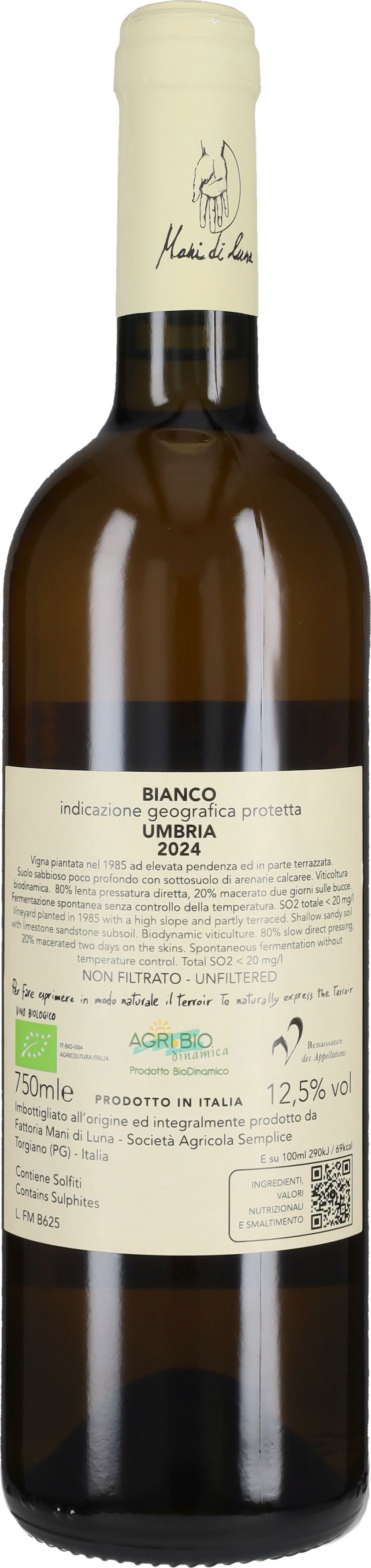
Bianco 'Il Baratto' Fattoria Mani di Luna 2024Fattoria Mani di Luna presenta ‘Il Baratto’, un vino bianco artigianale che deriva da un assemblaggio di vitigni autoctoni e che, come afferma la stessa cantina, esprime un carattere territoriale più che varietale. La valorizzazione del terroir passa attraverso una filosofia produttiva sinceramente naturale, che abbraccia l’agricoltura biologica e quella biodinamica. Il nome della bottiglia si riferisce all’omonimo vigneto di 45 anni, ripido e in parte terrazzato, da cui provengono le uve.‘Il Baratto’ della cantina Fattoria Mani di Luna viene elaborato da un assemblaggio di Trebbiano Toscano, localmente chiamato Procanico, due tipi di Malvasia, Grechetto e anche RIesling. Il vigneto di origine, impiantato nel 1975, prende il nome di “Vigna Baratto”, ed è situato a 200-300 metri di altitudine su terreni ripidi e in parte terrazzati, composti da sabbie, argille e arenarie da antichi sedimenti marini e lacustri. La raccolta si verifica a mano e, successivamente, i grappoli sono pressati interi in un torchio verticale. La lenta fermentazione alcolica ha luogo spontaneamente in acciaio per 2-3 settimane, cui seguono 7 mesi di maturazione sulle fecce fini sempre in vasche d’acciaio, con periodici batonnage. L’imbottigliamento avviene in fase di luna calante, senza alcuna chiarifica o filtrazione.Alla vista, il bianco umbro ‘Il Baratto’ Fattoria Mani di Luna mostra una colorazione giallo paglierino tenue. Lo spettro olfattivo è delicato e fruttato, definito da sentori di camomilla, gelsomino, mele, fiori di campo e macchia mediterranea, associati a leggere nuance minerali e di idrocarburi. Sorso fresco, armonioso e beverino, di dissetante leggiadria. Un’interpretazione originale che ben si presta ad accompagnare stuzzichini e antipasti vari dal sapore delicato.19,00 £*Shipping: 48,00 £Secure redirect to the provider
-
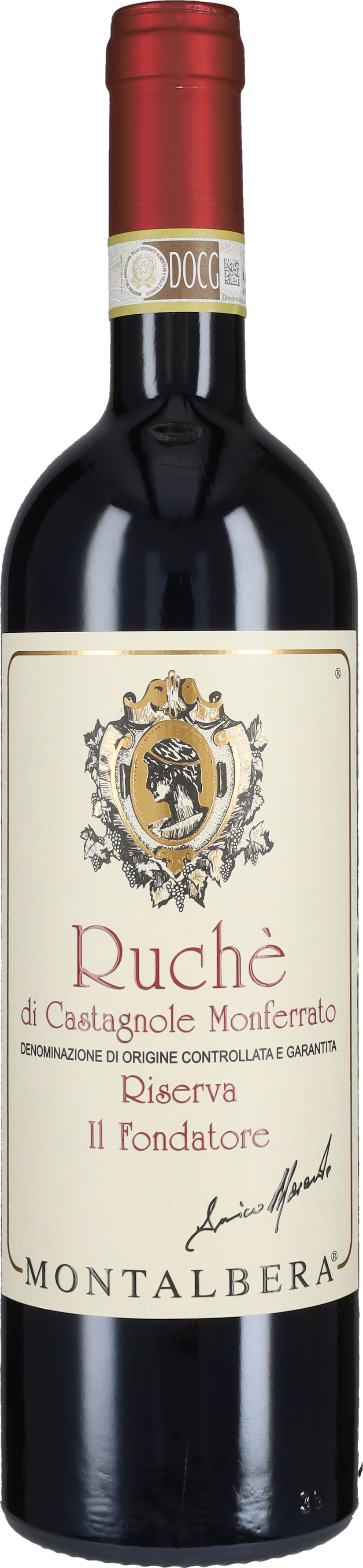
Ruché di Castagnole Monferrato 'Il Fondatore' Montalbera 2023Il Ruché di Castagnole Monferrato “Limpronta” di Montalbera è un vino tipico del territorio dell’astigiano, realizzato con un antico vitigno a bacca rossa diffuso soprattutto nell’area del piccolo comune di Castagnole. Si tratta di un’uva leggermente aromatica, che marca i vini con caratteristiche note floreali e speziate di grande tipicità e riconoscibilità varietale. Un’etichetta che permette di scoprire in purezza le migliori qualità del vitigno, regalando un’esperienza gustativa unica e irripetibile. Il Ruché “Limpronta” è uno dei vini di punta della cantina piemontese Montalbera. Sono ben 82 gli ettari della tenuta coltivati a Ruché, pari a circa il 60% del totale. Le vigne si trovano nella zona di confine tra il Monferrato e le Langhe, all’interno dei territori comunali di Grana, Castagnole Monferrato e Montemagno. Si tratta di una magnifica zona collinare, caratterizzata da splendide esposizioni soleggiate e terreni molto vocati di matrice calcareo-argillosa. Le vigne hanno un’età media che varia dai 7 ai 30 anni e sono allevate a Guyot basso. Terminata la vendemmia, si procede alla fermentazione in vasche d’acciaio inox a temperatura controllata. Il vino matura per un periodo di circa 10-14 mesi in tonneau di rovere francese e conclude l’affinamento con alcuni mesi di bottiglia, prima d’essere messo in commercio. Il “Limpronta” Ruchè è un rosso atipico, florale, speziato, aromatico, dalla personalità inconfondibile. Un’etichetta di carattere, indissolubilmente legata al piccolo territorio di produzione. Nel calice si presenta con una veste color rubino con sfumature granato. Il bouquet è seducente, con profumi floreali, sentori speziati, cenni di pepe nero e aromi di piccoli frutti di bosco a bacca scura. Il sorso è aromaticamente ricco e complesso, con ritorno al palato di piacevoli note di morbide spezie orientali. I tannini sono fini e gentili, il finale è persistente ed esprime grande armonia ed equilibrio gustativo.20,00 £*Shipping: 48,00 £Secure redirect to the provider
-
What does 'Rucke di guck, Rucke di guck, Blut ist im Schuh' mean?
"Rucke di guck, Rucke di guck, Blut ist im Schuh" is a German nursery rhyme that translates to "Rock-a-bye baby, blood is in the shoe" in English. The rhyme is a traditional lullaby that tells the story of a baby being rocked to sleep while blood is found in their shoe, which is a metaphor for the baby being cared for and protected. The rhyme is meant to soothe and comfort children as they drift off to sleep. **
-
What comes after il faudrait in French?
In French, "il faudrait" is followed by the infinitive form of a verb. This construction is used to express a suggestion or a polite request. For example, "il faudrait partir tôt" means "it would be necessary to leave early." **
-
How does "il faut" work in French?
"Il faut" is a common expression in French that is used to convey the idea of necessity or obligation. It is followed by an infinitive verb and is used to express what needs to be done or what is necessary in a given situation. For example, "Il faut manger" means "It is necessary to eat." This expression is used to give advice, make suggestions, or express general truths. **
-
What is an El, Sl, and Il?
An El, Sl, and Il are all suffixes used in the English language to form adjectives. "El" is used to form adjectives that mean "pertaining to" or "characterized by," such as in the word "musical." "Sl" is used to form adjectives that mean "tending to" or "inclined to," such as in the word "careful." "Il" is used to form adjectives that mean "having the nature of" or "capable of," such as in the word "flexible." These suffixes help to create new adjectives by modifying the meaning of the base word. **
* All prices are inclusive of VAT and, if applicable, plus shipping costs. The offer information is based on the details provided by the respective shop and is updated through automated processes. Real-time updates do not occur, so deviations can occur in individual cases. ** Note: Parts of this content were created by AI.